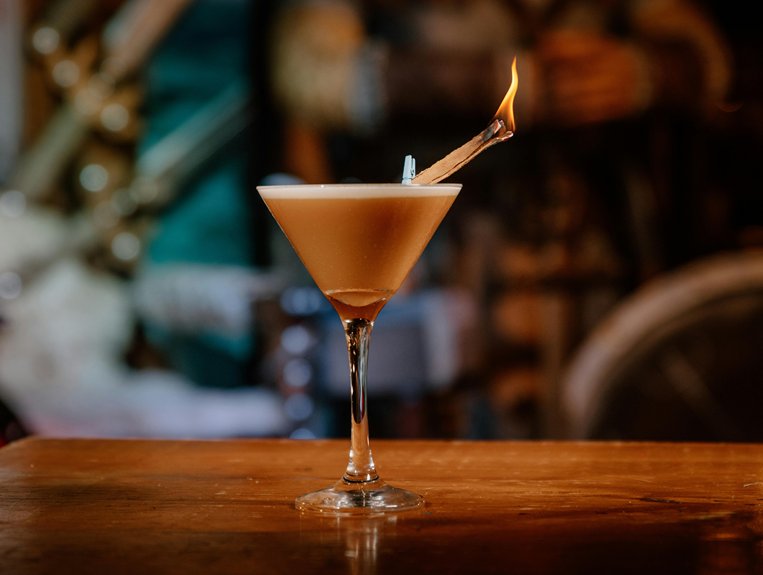
The name “cocktail” likely came from 1690s England, where apothecaries mixed bitters with spirits. By 1806, the Balance and Columbian Repository officially defined it: spirits, sugar, water, and bitters. But here’s where it gets interesting—historians still debate the actual origin. Did it come from a mispronounced French word “coquetier” (eggcup)? Tavern barrel dregs? Or horses with docked tails? Each theory has fans. The full story behind this beloved drink’s name is surprisingly layered.
English Origins: Apothecaries, Bitters, and Early Practice (1690s–1780s)
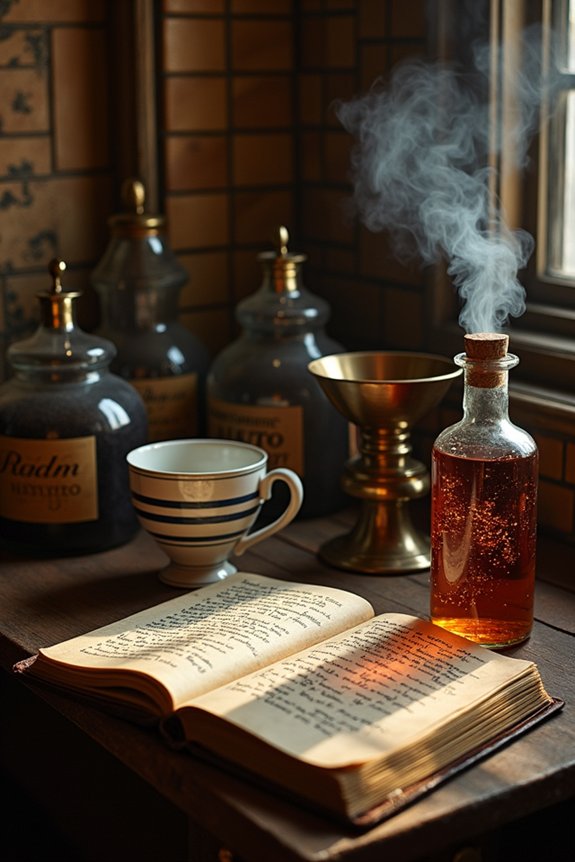
When did people first start calling mixed drinks “cocktails”? The answer traces back to 1690s England, where apothecaries like Richard Stoughton sold bitters specifically designed to combine with spirits. These early mixed drinks weren’t fancy—they were practical. Apothecaries mixed bitters with brandy to create what they called a genuine cocktail, blending medicinal herbs with alcohol for stimulating effects.
By the 1780s, the term had solidified in English culture. The 1785 Classical Dictionary of the Vulgar Tongue documented cocktail usage, confirming the word’s growing popularity. These mixed drinks represented a shift in how people consumed spirits. Rather than drinking them straight, folks were experimenting with combinations that mellowed harsh flavors while adding complexity.
English origins shaped everything that followed, influencing American drinking culture decades later.
Three Theories That Shaped the Name: Eggcups, Barrel Dregs, and Docked Horses
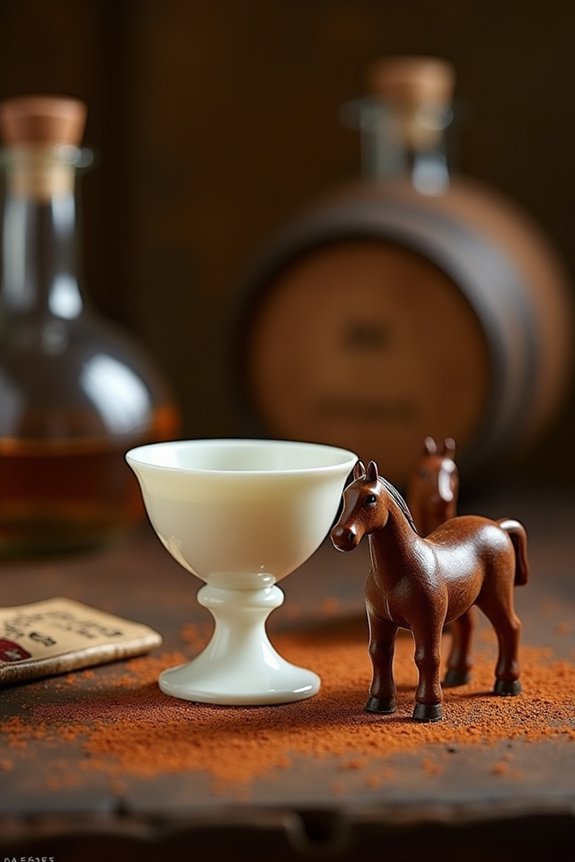
How’d a drink get its name? Three competing theories explain the cocktail’s origin. The eggcup theory suggests French bartender Peychaud mispronounced “coquetier”—a French eggcup—as “cocktay,” eventually becoming “cocktail.” The barrel dregs theory points to tavern owners mixing leftover spirits from multiple barrels. They called the spigot a “cock,” linking cock tailings to these mixed drinks. The docked horses theory references 17th-century slang: “cock tail” described horses with trimmed tails, suggesting something lively and spirited. By 1806, *The Balance and Columbian Repository* formally defined cocktail as a stimulating liquor combining spirits, sugar, water, and bitters. Each theory connects a visual or linguistic cue—egg cup, tailing, or docked tail—to naming mixed drinks, showing how cross-cultural references shaped the term’s emergence.
The 1806 Definition That Stuck
The 1806 definition broke down the stimulating liquor into its essential parts:
- Spirits of any kind (your base alcohol)
- Sugar (for sweetness)
- Water (for balance)
- Bitters (for complexity and depth)
This mixed drink formula became the anchor point. Earlier references from 1803–1804 mentioned cocktails casually, but they didn’t explain what actually went into one. The 1806 definition changed everything. It separated the beverage sense from older horse-related uses. Suddenly, people knew exactly what contains spirits and bitters in a proper cocktail.
Nineteenth-Century Refinement: From Tavern Drink to Signature Cocktails
Once that 1806 definition circulated, bartenders stopped treating cocktails as random bar mixtures and started treating them as actual recipes worth perfecting. Jerry Thomas changed everything in 1862 when he published *How to Mix Drinks*. His guide systematized cocktail terminology and showed that spirits, sugar, water, and bitters weren’t just ingredients—they were the foundation of something real. By the 1890s, bartenders recognized distinct categories within mixed drinks. The highball emerged as its own thing: spirit plus mixer. Meanwhile, classics like the Old Fashioned stayed true to that original 1806 concept. These weren’t tavern experiments anymore. They were signature cocktails with purpose. Reference works from 1869 and 1902 kept reinforcing these standards. You weren’t just grabbing bottles. You were crafting something intentional.
Prohibition, Gin, and the Birth of Modern Mixology
Everything changed in 1920 when the United States banned alcohol. Prohibition forced bartenders underground into Speakeasies, where they had to get creative with limited supplies. Here’s what happened to cocktails during this era:
- Gin became the spirit of choice because it was easier to produce illicitly than aged whiskey
- Bartenders created quick, shareable punch-style drinks designed for fast consumption during raids
- Bitters and other masking flavors hid the poor quality of illicit spirits
- Reformulation became essential as bartenders simplified recipes to work with whatever ingredients they could access
This period fundamentally reshaped modern mixology. Bartenders stopped focusing on balance and craft, instead prioritizing accessibility and portability. After Prohibition ended in 1933, a restorative drink movement emerged. Mixologists reclaimed their profession, developing the formalized techniques and gin-centered cocktails we recognize today as modern mixology.