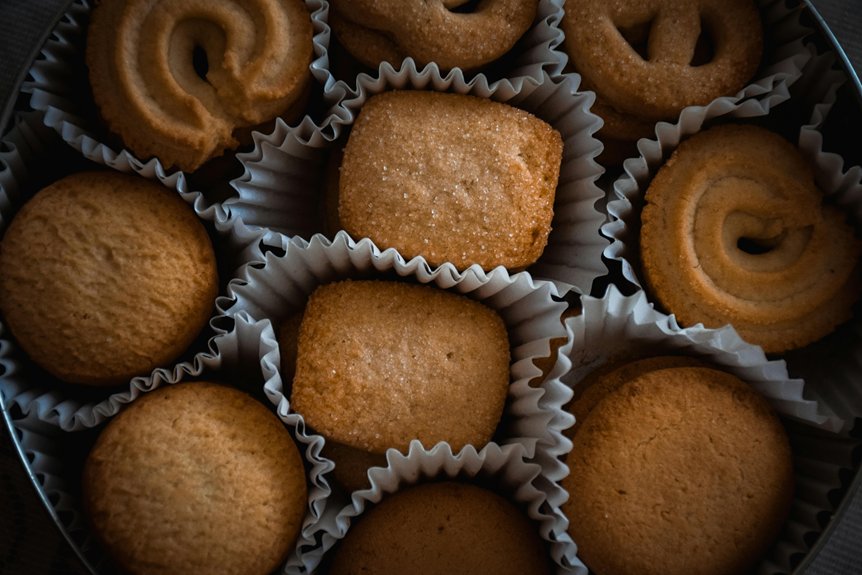
Cookies started in 7th-century Persia as test cakes for checking oven temperatures, then traveled west through Dutch traders who called them “koekje”—meaning “little cake.” Sugar from trade routes transformed them from hard rations into sweet treats. Medieval bakers made twice-baked biscuits for long voyages, while Renaissance cookbooks elevated cookies with eggs and spices for wealthy tables. By the 1600s, English settlers brought these recipes to America, and industrial factories later made cookies affordable for everyone. Keep exploring to uncover how accidents like Ruth Wakefield’s chocolate chip discovery shaped modern baking.
Ancient Persia: The Birthplace of Cookie-Style Cakes
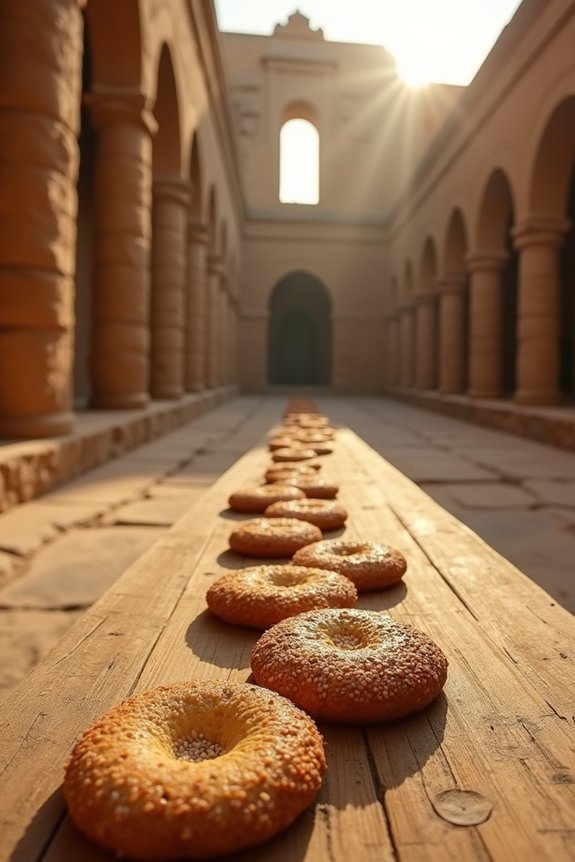
Ever wondered why cookies exist at all? I’ll trace their origins back to 7th-century Persia, where sugar cultivation revolutionized baking. Bakers there created small, sweetened cakes called test cakes. Here’s why: they baked these little treats before making larger cakes to check if their ovens reached the right temperature. This practical method became popular across Persia.
The Dutch later borrowed this concept, calling these treats “koekje,” meaning little cake. That word eventually became our modern “cookie.”
Sugar knowledge spread through the Muslim world, the Crusades, and spice trade routes. By the 14th century, European aristocracy enjoyed cookies too. What started as a clever baking trick in Persia transformed into the treats we love today. You’re holding centuries of history in every bite.
The Dutch Connection: How “Koekje” Became “Cookie”
How’d a Dutch word end up describing America’s favorite sweet treat? The answer traces back to the 1600s when Dutch settlers arrived in New Amsterdam, now New York City. They brought koekje—meaning “little cake” in Dutch—along with their baking traditions. This simple word transformed American baking vocabulary forever.
Dutch influence shaped how we categorize baked goods. While Europeans called their hard, twice-baked treats “biscuits,” Americans adopted “cookie” for softer, chewier varieties packed with sugar and fat. Early American cookbooks actually placed cookies at the end of cake chapters, listing treats like Jumbles and Plunkets. These quirky names show how terminology evolved after Dutch settlers arrived.
The shift from koekje to cookie standardized an entire category of baked goods unique to American culture.
Sugar’s Journey: How Persian Trade Routes Transformed Cookie Recipes
When you trace sugar’s path from Persian fields in the 7th century, you’ll discover how this ingredient fundamentally changed what people baked and ate across continents. I want you to picture traders moving sugar westward through Muslim networks, the Crusades, and spice routes—each journey introducing new sweetening techniques that European bakers gradually adopted and refined. By the 14th century, these Persian-inspired recipes had transformed European cookie-making from simple test cakes into the sweeter, more complex confections that graced aristocratic tables.
Sugar’s Persian Cultivation Origins
If you’ve ever wondered why cookies became so popular in Europe during the Middle Ages, you can thank Persia. In the 7th century, Persian cultivators began growing sugar—something nobody else had mastered yet. This discovery changed everything about baking.
Here’s how sugar’s diffusion from Persia transformed cookie-making:
- Persian farmers perfected sugar cultivation around the 7th century, creating a reliable supply for cooking
- Knowledge spread westward through Muslim traders, crusaders, and spice merchants crossing established routes
- Simple small cakes emerged as bakers experimented with newly available sugar in their recipes
- By the 14th century, cookies flourished across Europe, reshaping aristocratic and urban baking traditions
Sugar wasn’t just an ingredient. It was the spark that ignited cookie culture across continents. Without Persia’s agricultural innovation, your favorite treats wouldn’t exist.
Trade Routes Spreading Sweetness
Why did cookies spread so rapidly across Europe once Persia figured out sugar cultivation? Trade routes became the highways of sweetness. Merchants didn’t just carry sugar eastward and westward—they transported the actual cookies too, along with recipes and baking techniques. You’ll find this exchange happening through the Crusades and Muslim expansion into Spain, where Persian pastry knowledge merged with European traditions. The trade networks connected spice markets to cookie-making innovations. This cross-cultural sharing meant Italy developed biscotti while other regions created their own versions. The Dutch word “koekje” entered English vocabularies, showing you how deeply these exchanges shaped language itself. By the 14th century, cookies weren’t exotic anymore. They’d become everyday treats across Europe, from royal courts to street vendor stalls, thanks entirely to these connected trading pathways spreading ingredients and ideas together.
European Recipe Transformation Through Commerce
As trade routes connected Europe to Persian sugar sources, something remarkable happened to cookie recipes themselves. I’ll show you how commerce transformed baking across the continent.
- New ingredients arrived: The spice trade brought cinnamon, nutmeg, and cloves into European kitchens, making cookies more complex and flavorful than ever before.
- Renaissance experimentation flourished: Bakers combined dried fruits and nuts with these exotic spices, creating regional specialties like Italian biscotti that we still enjoy today.
- Guilds standardized quality: Professional baker guilds established consistent standards, ensuring cookies met specific requirements for texture and taste.
- The word “biscuit” stuck: From the Latin “bis coctum” (twice baked), this term reflected the actual baking technique that became essential to European cookie-making.
Commerce didn’t just bring ingredients—it transformed how Europeans baked and named their creations.
Medieval Biscuits: Twice-Baked Durability Meets Street Food Culture
Medieval bakers regularly created hard, dry biscuits that could survive months-long journeys without spoiling. The term “biscuit” itself comes from Latin—bis coctum—meaning twice baked. This twice-baked technique involved baking dough once, then drying it again to remove moisture. This durability made medieval biscuits essential for sailors and travelers heading out on long voyages.
These biscuits weren’t just survival food, though. Street vendors in medieval towns sold them as everyday snacks to regular people. You’d find them at markets, and they became popular enough that common folk relied on them. The twice-baked method locked in freshness longer than softer breads. This combination of durability and street food appeal helped biscuits become a staple across Europe. The tradition stuck around because it simply worked.
Renaissance Cookbooks: When Cookies Became Fashionable
As you trace cookies through Renaissance Europe, you’ll notice cookbooks like Thomas Dawson’s 1596 *Goode Huswifes Jewel* and Gervase Markham’s 1615 *The English Hus-wife* suddenly feature rich recipes with egg yolks, spices, and refined techniques that transformed cookies from simple test cakes into fancy desserts. These published recipes reveal how sugar—increasingly available and affordable in Europe during the 16th and 17th centuries—became a key ingredient that made cookies desirable status symbols in elite courts and urban centers. Bakers’ guilds and growing commercial operations then standardized these sophisticated cookie formats, spreading what was once a luxury item to broader audiences beyond the wealthy.
Rich Recipes And Ingredients
The Renaissance transformed cookies from simple, everyday baked goods into luxurious treats worthy of wealthy tables. I’ll show you how ingredient lists grew richer and more complex during this period.
Early cookies relied on basic components, but Renaissance bakers elevated baking traditions with sophisticated additions:
- Egg yolks enriched doughs, creating tender textures that impressed nobles
- Multiple spices like cinnamon, ginger, and nutmeg signaled wealth and exotic trade connections
- Quality sugar replaced honey, offering refined sweetness that defined luxury
- Flour, eggs, and sugar combined in formalized ratios, documented in printed cookbooks
Thomas Dawson’s 1596 cookbook and Gervase Markham’s 1615 English Hus-wife recorded these precise methods. Print culture standardized cookie history and baking traditions, linking ingredients and flavors to high-society dining. These early cookies evolved from test-bakes into elaborate confections that demonstrated culinary skill and social status.
Cookbooks Spread Cookie Culture
How did cookies transform from simple street snacks into fashionable desserts served at elite tables? Renaissance cookbooks played a pivotal role. I’ll show you how printed recipes elevated cookies from ordinary treats to refined confections.
| Cookbook | Year | Key Innovation |
|---|---|---|
| Goode Huswifes Jewel | 1596 | Square short-cookies with egg yolks and spices |
| English Hus-wife | 1615 | Standardized jumbles recipes using eggs |
| Various Collections | 1600s | Expanding spice and ingredient access |
Thomas Dawson’s *Goode Huswifes Jewel* introduced square short-cookie recipes enriched with egg yolks and spices, showing advanced techniques that impressed aristocrats. Later, Gervase Markham’s *English Hus-wife* provided two jumbles recipes with egg-based formulas. These Renaissance cookbooks standardized cookie-making knowledge. Expanding trade and culinary exchange spread this information from Europe to households and print culture. Suddenly, you could follow written instructions and create cookies worthy of noble tables yourself.
Sugar’s Growing European Influence
While cookbooks standardized cookie-making techniques, there’s another ingredient that truly transformed these treats from simple snacks into luxury items: sugar. I’ll show you how this sweetener reshaped European confectionery forever.
Here’s what changed during the Renaissance:
- Sugar became affordable enough for more households to use regularly, not just for special occasions
- Trade routes brought exotic ingredients like spices, dried fruits, and nuts alongside sugar supplies
- Bakers combined these new materials into innovative recipes that appealed to both wealthy families and common people
- Professional kitchens began experimenting with sugar-based techniques, creating richer, more complex cookie varieties
This ingredient shift didn’t happen overnight. As sugar’s cost gradually decreased across Europe, cookie-making evolved from a basic craft into an art form. Suddenly, you could find cookies flavored with cinnamon, studded with almonds, or topped with candied orange peel. That’s when cookies truly became desirable.
English Settlers Bring Tea Cakes to Colonial America
When English, Scotch, and Dutch immigrants sailed to colonial America, they packed more than just their belongings—they brought their beloved cookie recipes. These settlers introduced butter cookies that resembled teacakes and shortbread, creating a foundation for American baking traditions. Southern colonial housewives embraced these treats, often calling them “tea cakes” and flavoring them with butter and rose water. The Dutch influence proved particularly strong—our modern word “cookie” actually comes from the Dutch word “koetje,” meaning “little cake.” Early American cookbooks reflected this blend of traditions, placing cookie recipes alongside cakes and using names like Jumbles and Plunkets. By 1796, Amelia Simmons’s American Cookery featured cookie recipes, marking their established place in American culinary culture.
Tea Cakes, Jumbles, and Cry Babies: Colonial America’s Cookie Names
When I trace colonial cookie names, I find they tell you everything about what colonists valued and how they baked. You’ll notice “tea cakes” dominated because butter and rose water flavored these treats for afternoon tea, while quirky names like Jumbles and Cry Babies appeared in early American cookbooks, reflecting both the regional preferences and the playful naming conventions of the era. The Dutch influence shows up clearly too—the word “cookie” itself comes from the Dutch “koetje,” meaning “little cake,” so these desserts carried their linguistic roots right into colonial American kitchens.
Colonial Naming Conventions
How did colonists decide what to call their cookies? They borrowed heavily from their heritage while adapting to their new world. I’ve found that colonial naming conventions reveal fascinating patterns:
- Dutch influence shaped the word itself – “cookie” comes from the Dutch koekje, meaning “little cake,” reflecting New Amsterdam settlers’ impact on American vocabulary.
- Tea cakes dominated Southern tables – colonial housewives called butter and rose-water flavored treats “tea cakes,” served alongside hot beverages at social gatherings.
- British names persisted in recipes – Jumbles and Plunkets appeared in early American cookbooks, showing strong English cookie terminology roots.
- Regional preferences created distinct labels – as colonists adapted recipes to local ingredients, they gradually developed uniquely American cookie terminology rather than simply copying European names.
This naming evolution tells us how settlers merged their traditions with new possibilities.
Regional Flavor Preferences
Why did colonial bakers call the same type of cookie by three different names depending on where they lived? The answer lies in regional flavors and colonial influence. English settlers preferred spiced Jumbles with warm cinnamon and nutmeg. Dutch immigrants favored butter-rich treats reflecting their koekje traditions. Scottish bakers added oats and molasses to their versions. These cookie origins show how naming traditions varied across colonies based on available ingredients and cultural backgrounds. A baker in Boston might create molasses-heavy Cry Babies, while a Philadelphia baker made delicate, lemon-flavored tea cakes. These weren’t different cookies—they were the same concept dressed in regional flavors. Understanding these variations helps you trace how colonial influence shaped American baking traditions and created our diverse cookie heritage today.
How Baking Guilds Standardized Cookie and Biscuit Quality
Ever wonder why cookies from different bakeries actually taste somewhat similar? I’ll tell you why. Back in the 17th and 18th centuries, baking guilds took control. They weren’t messing around.
Here’s how they standardized everything:
- Master bakers set strict rules for ingredients—soft wheat flour, sugar, and fats like butter had to meet exact standards
- They regulated both quality and quantity so biscuits couldn’t be skimped on or oversized
- Apprentices learned identical techniques, spreading consistent methods across regions
- Hard tack sailors’ biscuits and tea-time biscuits followed the same guild-approved formulas
This standardization stuck around. When the Industrial Revolution hit, factories adopted these guild practices for mass production. That’s why your chocolate chip cookie tastes familiar whether you’re in Boston or Birmingham. The baking guilds basically created the cookie blueprint we still follow today.
Ships’ Biscuits and Hardtack: Portable Cookies for Voyages
I’ll trace how sailors needed portable food that could survive months at sea, which led bakers to create hardtack—a rock-hard biscuit that stayed fresh without refrigeration or preservatives. You can see this necessity drove innovation in baking techniques, as the dense, low-moisture composition of these biscuits prevented spoiling during long maritime voyages where fresh provisions weren’t available. These practical cookies became the blueprint for shelf-stable baked goods we still make today, proving that sometimes the toughest solutions create the longest-lasting results.
Long-Lasting Preservation Methods
When sailors set out on voyages lasting months or even years, they needed food that wouldn’t spoil in the salty, humid air of the ocean. We can trace how preservation methods shaped early cookie history by looking at the practical solutions sailors used.
- Long-baking techniques removed moisture content from dough, which stopped mold and bacteria from growing
- Hardtack biscuits were baked twice to achieve maximum dryness, extending shelf-life considerably
- Low-moisture formulas used minimal water and salt, creating rock-hard cookies that lasted indefinitely
- Storage conditions in cool ship holds kept these provisions stable for years
The long-baking process wasn’t complicated. Bakers simply baked dough until it became extremely hard and dry. This transformed ordinary biscuits into durable rations. Sailors depended on these shelf-stable cookies as reliable caloric sources during dangerous maritime expeditions throughout the 17th and 18th centuries.
Maritime Travel Requirements
How did sailors keep food from spoiling during months-long ocean journeys? They relied on hardtack—a twice-baked biscuit that became the gold standard of shipboard provisions. Unlike regular cookies, hardtack was engineered for extreme durability. Bakers created these rock-hard biscuits by baking dough twice, removing all moisture that could invite mold or rot.
The shelf-life of hardtack stretched across years when stored in barrels with minimal exposure to humidity. This wasn’t gourmet eating; sailors often soaked hardtack in water or coffee just to bite through it. The biscotti tradition influenced this shipboard baking approach, emphasizing dryness and stability over flavor. Later innovations like ANZAC biscuits built on these principles, giving troops portable nutrition engineered to survive rough seas and long voyages without spoiling.
How the Industrial Revolution Changed Cookie Production
Because factories and machines emerged in the 1800s, cookie production transformed from a home and bakery craft into a massive commercial operation. I’ll walk you through how this shift changed everything:
- Mass production replaced hand-mixing—machines now combined soft wheat flour, sugar, and fats at scale, churning out thousands of cookies daily instead of dozens.
- Biscuit companies like Nabisco and Huntley & Palmers standardized recipes, ensuring every cookie tasted identical across batches and locations.
- Packaging innovations revolutionized distribution—decorative tins protected cookies during long journeys, making export worldwide suddenly practical and profitable.
- Variety exploded—factories experimented with new flavors and shapes faster than home bakers ever could, creating the diverse cookie selection we enjoy today.
This Industrial Revolution moment democratized cookies, moving them from luxury items into affordable staples.
Brownies Go Mainstream: Sears’s 1897 Catalog Moment
The 1897 Sears Roebuck catalog did something remarkable—it published the first widely distributed brownie recipe, and that single moment changed how Americans baked at home. Before this, brownies weren’t a household staple. The catalog’s recipe introduction brought chocolate desserts into kitchens across the country, making them accessible to everyday families.
Following Sears Roebuck catalog’s success, cookbooks jumped on the trend. The Boston Cooking-School Cook Book featured brownies in 1906, and Lowney’s Cook Book followed in 1907. These publications cemented brownies’ place in American baking culture.
Regional variations emerged too. The Bangor Brownies became a notable early adaptation, showing how communities made the recipe their own. This period marked when brownies transformed from novelty to necessity, reflecting America’s growing chocolate desserts obsession and expanding home baking movement.
The Chocolate Chip Cookie: An Accidental 1930s Invention
When Ruth Wakefield chopped up a Nestlé semi-sweet chocolate bar and stirred it into her butter cookie dough in 1938, she didn’t invent the chocolate chip cookie on purpose—she created it by accident. She expected the chocolate to melt completely. Instead, the chips held their shape, creating something entirely new at her Toll House Inn in Massachusetts.
Ruth Wakefield’s accidental chocolate chip cookie invention in 1938 transformed American baking when chopped chocolate refused to melt.
Here’s how this accident changed American baking:
- The unexpected texture surprised Wakefield when the chocolate chips didn’t blend into the dough
- Nestlé recognized the opportunity and struck a deal in 1939 to print Wakefield’s recipe on chocolate bar wrappers
- The recipe spread nationwide, turning a bakery innovation into a household staple during America’s 1930s baking surge
- The Toll House branding cemented this flavor profile in American culinary memory for generations
Ruth Graves Wakefield’s Toll House Cookie Legacy
How did one baker’s happy accident become America’s favorite cookie? Ruth Wakefield, owner of the Toll House Inn in Massachusetts, created the chocolate chip cookie in 1938 by chopping Nestlé semi-sweet chocolate into her butter-rich dough. Her recipe featured brown sugar, eggs, flour, and vanilla, producing that signature soft, chewy texture we still love today.
Nestlé recognized the recipe’s potential and purchased the rights in 1939. They printed Wakefield’s formula directly on chocolate bar wrappers, sparking nationwide demand. This partnership transformed a kitchen experiment into an American staple. Her Toll House name became synonymous with quality chocolate chips and home baking itself.
Wakefield’s legacy shaped cookie culture for generations, establishing chocolate chips as a baking essential alongside classics like peanut butter and oatmeal raisin varieties.
From ANZAC Biscuits to Animal Crackers: Global Cookie Culture Today
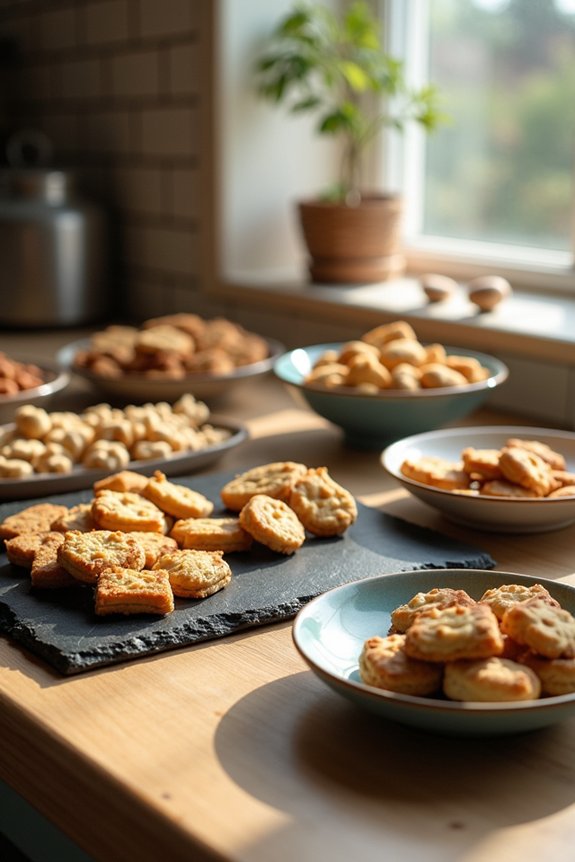
While Ruth Graves Wakefield was perfecting her chocolate chip recipe in Massachusetts, bakers across the ocean were creating their own iconic cookies that’d endure just as long.
- ANZAC biscuits emerged in Australia and New Zealand during WWI, designed as long-shelf-life treats for two-month ocean voyages to Gallipoli
- Scottish immigrants brought oat cake traditions that shaped these hard, durable biscuits for preservation
- Animal Crackers started in England as “Animals,” then became domestically produced before Nabisco claimed them
- Christopher Morley’s poem and Barnum’s packaging cemented these cocoa-flavored treats in American comfort-food culture
The global cookie culture you’re part of today connects ancient preservation methods to modern nostalgia. These cookies bridged continents and generations, showing how practical baking solutions became beloved traditions that’d define entire nations’ identities.